Observation start time: 08:30:00 Observation end time: 15:00:00 Total observation time: 6.5 hours
Official Counter: Ken Tucker
Observers: Diane Stewart
Visitors: Two women from Idaho on a Two and half month trip to New England with their husbands. Many leaf peepers
Weather: Mostly sunny, medium SSW winds, wind speed varied greatly within each hour
Raptor Observations: One adult Golden Eagle, 4 Balds, several falcons.
Non-raptor Observations: Blue Jays, Yellow rumpled warblers, white breasted nuthatch, cedar waxwings. ======================================================================== Report submitted by Darrell Smith (<oleagleye...>)
Observation start time: 10:45:00 Observation end time: 15:00:00 Total observation time: 4.25 hours
Official Counter: Connor Schmitt
Observers: David Kyler, Ken Bowman, Trudy Kyler
Visitors: Trail runner, a local couple, and 3 hikers all stopped by briefly.
Weather: Late start to the day as the fog took all morning to lift. Luckily it eventually did. Overcast all day until the clouds broke up around 2-3pm. Good winds from the NW.
Raptor Observations: Slower day than expected.
Non-raptor Observations: Non-raptors: Pileated Woodpecker, Blue Jay, Ravens, Tree Swallows (~200). Starlings, Waxwings, Goldfinch. Warblers: Yellow-rump
Predictions: Southern winds, so probably a bit slow. ======================================================================== Report submitted by Connor Schmitt (<cschmitts12...>)
Date: 10/12/26 4:16 pm From: Hawkcount.org reports <reports...> Subject: Bald Eagle Mountain - Eagle Field (12 Oct 2026) 48 Raptors
Bald Eagle Mountain - Eagle Field State College, Pennsylvania, USA Daily Raptor Counts: Oct 12, 2026 -------------------------------------------------------------------
Observation start time: 11:00:00 Observation end time: 16:30:00 Total observation time: 5.5 hours
Official Counter: Nick Bolgiano
Observers:
Weather: Low clouds early after all-day rain yesterday. Wind WNW/WSW 5-12 mph, overcast becoming thin clouds, temp 61-69F
Raptor Observations: GE: 1545 Juv, crossed from BE Mt to the Allegheny Front foothills
BE: 3Ad, 1Imm
This is the first watch day for 2026. This site concentrates on the Golden Eagle migration, with watches only on favorable W/NW winds.
Non-raptor Observations:
Predictions: Saturday has an excellent forecast of NW wind 12-15 mph.
Hawk watchers are welcome. ======================================================================== Report submitted by Nick Bolgiano (<nickbolgiano...>)
Observation start time: 08:00:00 Observation end time: 14:30:00 Total observation time: 6.5 hours
Official Counter: Jen Lee
Observers: Diane Stewart
Visitors: Couple leaf peepers, a few asked what we were seeing. One fellow suggested we look out for Condors.
Weather: Thick clouds just above towers for first 3 hrs. In/out of lower whispy clouds at watch. 8-10 mph NW winds all morning, a little less afternoon. Mid 60s. First bigger openings of blue sky not until 1:30.
Raptor Observations: First bird Red-shouldered (8:26am). Sharpies were first spotted slipping out of the clouds for short views. I'm sure we missed a bunch that stayed in the clouds. Small movement of Balds later.
Non-raptor Observations: 4 late Monarchs, a murder of Am. Crows, a conspiracy of Ravens (9 at one point), c.wren, downy, bluejay, goldfinch, cardinals. Towhee, w.th.sparrow, flicker, wb.nuthatch, chimney swift, tree swallows, modos, cedar waxwings. Sadly, no flamboyance of Flamingoes. Multiple Redtails, TVs, BVs, not counted. ======================================================================== Report submitted by Darrell Smith (<oleagleye...>)
Date: 10/12/26 3:10 am From: Constanza Ehrenhaus <cxe1169...> Subject: Big Sit! At Millbrook Marsh
Second Big Sit! Millbrook Marsh.- By the State College Bird Club and Millbrook Marsh.
Weather notes: A chilly and sunny early morning, turning warmer by 11, later becoming partially cloudy in the afternoon.
The team captain started at sunrise, and people joined starting at 7:27. Some new birders were there, and brought in curiosity and a great attitude. For many people, it was their fist Big Sit! and we are so honored that they chose to join us!
We had a nice variety of birds, and more than last year's Big Sit! 46, compared to 35, and I wonder if this difference was due to the tailgating celebrations being quieter this year and a no planes with ads flying low over us for hours. This year Hairy Woodpecker and Yellow-bellied Sapsucker decided to show up. Also, this year, the GBHE collaborated and showed up within the circle. Lots of Yellow-rumped Warblers, and huge flocks of Cedar Waxwings and Red-winged Blackbirds. Two Bald Eagles (one adult, one juvenile) flew very close to us at two moments, giving us great sights.
Susan and Ron brought us food. We enjoyed doughnut holes, apple cider (delicious!), brownies, and honey crisp apples. What a treat! They took over leading the circle and found the American Kestrel that last year teased us from outside the circle, and two Cooper Hawks. Later Joe found a Rusty Blackbird to reach our 46th species.
The birding was fun, the company great, and we together put 28:05 hours combined. Many thanks to all who joined, and we hope to see you there next year!
Many thanks to the Millbrook Marsh for hosting us!
Date: 10/10/26 2:52 pm From: Nick Bolgiano <nickbolgiano...> Subject: Fwd: Stone Mt. (10 Oct 2026) 23 Raptors
---------- Forwarded message ---------
From: <reports...>
Date: Sat, Oct 10, 2026 at 5:48 PM
Subject: Stone Mt. (10 Oct 2026) 23 Raptors
To: <nickbolgiano...>
*Stone Mt.*
Allensville, Pennsylvania, USA
*Daily Raptor Counts: *Oct 10, 2026
*Species* Day's Count Month Total Season Total
BV 0 18 18
TV 0 52 52
OS 0 4 45
BE 3 38 109
NH 2 9 17
SS 13 241 350
CH 0 20 38
AG 0 0 0
RS 0 5 7
BW 0 6 3461
RT 4 39 61
RL 0 0 0
GE 0 2 2
AK 0 27 45
ML 0 10 13
PG 1 8 13
UA 0 2 6
UB 0 1 9
UF 0 1 3
UE 0 0 0
UR 0 1 8
*Total:* 23 484 4257
Observation start time: 08:00:00
Observation end time: 15:30:00
Total observation time: 7.5 hours
Official Counter Nick Bolgiano
Observers:
*Visitors:*
Ean and Bryan Van Scyoc, Joshua Potter, David Miller
Date: 10/10/26 3:39 am From: Wentzel, Doug <djw105...> Subject: Shaver's Creek Big Sit is off and running
Hi all,
White-throated Sparrow was our first bird of the Shaver’s Creek Big Sit 2026, heard a little after midnight from our “circle” on the boardwalk. Best wishes to all those counting today or tomorrow! During our previous 18 years of participating in the Big Sit, we have recorded a total of 94 different species, and 11 of those have been seen each year. Come visit us if you want to check your answer or wait until we post our results and I’ll share if those 11 species made it to 19 years in a row.
Happy Saturday,
Doug
Doug Wentzel
Program Director & Naturalist
Shaver's Creek Environmental Center
The Pennsylvania State University
3400 Discovery Road
Petersburg, PA 16669-2114
Observation start time: 08:15:00 Observation end time: 15:00:00 Total observation time: 6.75 hours
Official Counter: Darrell Smith
Observers: Craig Kochel
Visitors: Craig Kochel was there when I arrived and stayed until 2:00. Glad he was there. His eyes are better than mine and the count would have been lower without him. His photos are amazing. Several groups of Amish looking over the 2 valleys. Some site seers. Bruce and Becky Hartman from my area of Martinsburg. George Farmont and Bob ? I messed up the spelling of his name from State College. I couldn't read my own writing. He was a geologist like Craig and they knew many of the same people. They had a great conversation. Sorry I messed up his last name.
Weather: Clear blue sky most of the day with Light winds from the WNW. Cool to start but warmed up quickly.
Raptor Observations: Imm. BE's 10:08,1:01. First bird was a Peregrine Falcon sipping through at 8:24, but Craig got a photo. He amazes me. One Adult BE not migrating. Local Red-tails, TV's and BV's.
Non-raptor Observations: Several Ravens and Nemo. Blue Jays and 4 Monarchs.
Predictions: ESE winds predicted at 5-10 mph. Should be a better day than today. ======================================================================== Report submitted by Darrell Smith (<oleagleye...>)
Observation start time: 09:30:00 Observation end time: 16:00:00 Total observation time: 6.5 hours
Official Counter: Alexa Sarussi
Observers: Jon Kauffman, Ken Bowman
Visitors: One group hiked through, a couple from Philadelphia, and a couple from Ohio, a family of 4 from State College hung out for a while in the afternoon, and towards the end of the day a large group of Amish enjoyed watching their cousins bale hay through the scope.
Weather: Beautiful fall day with clear skies until some wispy clouds started creeping in later in the afternoon. Warm temps and light winds.
Raptor Observations:
Non-raptor Observations: 9 monarchs moving through. Other birds: HAWO, YBSA, NOFL, PIWO, WBNU, RCKI, AMRO, BLJA, BCCH, CEWA, TUTI, TRSW, AMCR, CORA, AMGO, BTGW, EUST, BHVI (several singing actively in late morning), YRWA, DEJU, WTSP, EATO, TUVU, BLVU, RTHA ======================================================================== Report submitted by Jen Anderson (<jab56...>)
Date: 10/9/26 8:00 am From: Gyekis, Joseph Peter <jpg186...> Subject: Cape May warblers
for 3 days there have been a few cooperative cape mays on a small oak tree beside the theater building loading dock, pull in behind the hort woods child care center and look at the smaller oak with browner leaves. 4 cape mays and a sapsucker there now. free parking for 5 minute flashers, you can stand right beside your car assuming nobody is actively unloading a truck or something.
Observation start time: 09:00:00 Observation end time: 16:00:00 Total observation time: 7 hours
Official Counter: Cindy Bickel
Observers:
Visitors: Many today: The Smuller's (Jill's Mom was good friends with Gloria) from Linglestown; Terry Vansyoc, a Lewistown native who now lives in Alabama; Jared from Mt. Union (taking glam shots of his awesome car; an older couple who live north of Pittsburgh; and two firefighter/EMT's from Lewistown (A grandfather (Shawn) and grandson (Mason) duo). Enjoyed visiting with all and they helped to make a slow day go faster.
Weather: A beauty of a day at the watch. Cool to warm temperatures, cloudless to fluffy cumulus clouds, however west, northwest winds were very light throughout the morning finally picking up some after lunch. Limited flight was observed today.
Raptor Observations: First raptor of the day was at 9:07 bird time and was a local Red-tailed Hawk. All flight was out over Big Valley starting naked eye and then climbing further up and away from the top of the mountain starting around 11:00 bird time. Observed several escorting behaviors today between 2 different RT Hawks and then two separate RT Hawks being escorted through by Nemo, our resident Raven buddy.
Non-raptor Observations: Local TV's, BV's, BE, RT's, Ravens and Crows. Also observed Blue Jays, Cedar Waxwings, a few Doves and smaller birds as usual. ======================================================================== Report submitted by Darrell Smith (<oleagleye...>)
Observation start time: 08:30:00 Observation end time: 15:00:00 Total observation time: 6.5 hours
Official Counter: Ken Tucker
Observers: Phil Park
Weather: Clear blue skies, light winds from WNW. Temperature steady but felt very depending on sun or shade
Raptor Observations: One immature Bald not counted, saw a couple times hours apart, first flying toward the river from Big Valley, the couple hours flying from river towards Big Valley. Local Redtail(s) seen several times. One sharpie being harassed by a flock of crow, the shoe was on the other foot. Peregrine and Redtail interacting. Both Eagles count were subadults.
Non-raptor Observations: Approximately 40 crows pasting by. Carolina wren, cardinal, blue jays, towhee. Slow day in parking lot also
Predictions: Better ======================================================================== Report submitted by Darrell Smith (<oleagleye...>)
Observation start time: 08:45:00 Observation end time: 14:30:00 Total observation time: 5.75 hours
Official Counter: Connor Schmitt
Observers:
Visitors: Lynn Langer and Beth Leslie from outside Harrisburg. Camped at Canoe Creek the last few days and stopped by on their way home. Luckily for them most of the raptors for the day came by while they were present.
Weather: Sunny and high 60s. 5-7 mph winds from the southwest.
Raptor Observations: Very slow start to the day, that ended up being not too bad of a day.
Predictions: 7-12 mph winds from the west. May have decent numbers. ======================================================================== Report submitted by Connor Schmitt (<cschmitts12...>)
Observation start time: 07:45:00 Observation end time: 14:00:00 Total observation time: 6.25 hours
Official Counter: Jen Lee
Observers:
Visitors: Lots of leaf peepers but just the beginnings of some color to see. Won't be long with these cool nights.
Weather: Clear crisp morning with a 5-8 mph S wind. Mid-day the wind became more SW and slowed to 1-4 mph. AM hrs saw low fog in both valleys, clear on the ridges. The Lewistown half of Ferguson valley was blanketed and didn't clear until 930. Forecasted stronger winds did not appear at Jack's.
Raptor Observations: AM raptors were all eye level to the south at a distance. There may have been some taking a low route out of view. A few were spotted just above the guard rail. First bird, 8:35am, Sharpie.
Non-raptor Observations: Happy to see 6 more Monarchs! When the winds died back the bugs ramped up. Lanternflies, Stink bugs and some gnats made the last couple hrs unpleasant. Yel Rumped Warb, 4 Red Headed WP, Golden crowned kinglet, RB Nuthatch, Phoebe, Brown headed Cowbird, N.Flicker, Downy, Hairy, several Robins, and the other usual locals. ======================================================================== Report submitted by Darrell Smith (<oleagleye...>)
Date: 10/7/26 1:35 pm From: Constanza Ehrenhaus <cxe1169...> Subject: Afternoon-Evening shift for Big Sit at Millbrook Marsh
Hi all,
I am going to be leading the morning shift at the Big Sit at Millbrook, after that either Ron or Susan will take over from 11:30ish until 3/4 PM. Would anybody want to lead the 3:30 to dusk shift? This would be a great help.
Date: 10/6/26 5:46 am From: Constanza Ehrenhaus <cxe1169...> Subject: Big Sit! at Millbrook Marsh.
Hi all,
I will be leading the morning shift for the second Millbrook Marsh Big Sit!, and Susan Hart will be leading the afternoon effort. Millbrook Marsh is a sunrise to sunset environment, so consider this if planning to join. During the morning, there will be a volunteer opportunity to plant a new pollinator garden, this is sponsored by a State College Bird Club grant. Contact Susan Hart if you would like to help with its installation.
There will also be a Big Sit! at Shaver's Creek, and interested people are encouraged to attend both.
Observation start time: 08:00:00 Observation end time: 16:15:00 Total observation time: 8.25 hours
Official Counter: Connor Schmitt
Observers: Bill Chambers, David Kyler, Ken Bowman, Nick Bolgiano
Visitors: Ken and Mary Frazer.
Weather: Partly cloudy and mid 60s. 10-15 mph winds from the NW. Ideal conditions and it showed.
Raptor Observations: Golden Eagles: 2 juveniles / sub adults Kestrels: 5 females, 4 males, 10 unknown
First Golden Eagles of the season for Stone Mountain!
Non-raptor Observations: Non-raptors: 2 large dark shorebirds that may have been Hudsonian Godwits. Too distant too get a proper ID. Red-bellied Woodpeckers, Downy woodpecker, Flickers, Phoebe, Blue Jays, Ravens, Chickadee, Tree Swallows, WB Nuthatch, Starlings, Robins, Waxwings, Goldfinch, Junco, Towhee. Warblers: Tennessee, Cape May, Yellow-rump, Black-throated Green.
LFE: 1
Predictions: slower winds from the West-Northwest. Good have some more birds moving through. ======================================================================== Report submitted by Connor Schmitt (<cschmitts12...>)
Date: 10/5/26 5:01 pm From: Lee, Jen <jal21...> Subject: Re: Jacks Mountain (05 Oct 2026) 99 Raptors
31 Balds is 2nd best ever for Jacks Mt (35 is tops) and I'm told an amish fellow reported in late to todays counter that 8 more dropped out of the sky around 6:15-6:30. Our counters usually don't stay that late ! That's an awesome day of Bald Eagles !
From: State College (PA) Bird Club <SCBIRDCL...> On Behalf Of Hawkcount.org reports
Sent: Monday, October 5, 2026 7:21 PM
To: <SCBIRDCL...>
Subject: Jacks Mountain (05 Oct 2026) 99 Raptors
Observation start time:
07:00:00
Observation end time:
15:00:00
Total observation time:
8 hours
Official Counter
Craig Kochel , Diane Stewart
Observers:
Craig Kochel, Mark Shope
Visitors:
Ken and Mary Frazier from Glen Rock tried to go to Waggoner's today but said it was not available so they went to Stone. They left Stone and stopped in for a short visit with us.
Weather:
Cool with winds out of the WNW to start the day and then from the NW. Winds were in the 5-10 mph all day with gusts near 20 mph.
Raptor Observations:
EAGLES were on the move today. Many of the eagles were in groups of 2, 3, or 4. Local eagles were not counted.
Non-raptor Observations:
8 ravens kept us on our toes today. TV, BV, Towhee, bluebirds, pileated wp, 40 Canadian Geese which confused us at first due to their lack of formation. They eventually flew in formation. Goldfinch, Carolina Wren. Blue Jays, Cedar Waxwings. 5 BV were counted as migrating today. Locals were not counted.
Observation start time: 07:00:00 Observation end time: 15:00:00 Total observation time: 8 hours
Official Counter: Craig Kochel , Diane Stewart
Observers: Craig Kochel, Mark Shope
Visitors: Ken and Mary Frazier from Glen Rock tried to go to Waggoner's today but said it was not available so they went to Stone. They left Stone and stopped in for a short visit with us.
Weather: Cool with winds out of the WNW to start the day and then from the NW. Winds were in the 5-10 mph all day with gusts near 20 mph.
Raptor Observations: EAGLES were on the move today. Many of the eagles were in groups of 2, 3, or 4. Local eagles were not counted.
Non-raptor Observations: 8 ravens kept us on our toes today. TV, BV, Towhee, bluebirds, pileated wp, 40 Canadian Geese which confused us at first due to their lack of formation. They eventually flew in formation. Goldfinch, Carolina Wren. Blue Jays, Cedar Waxwings. 5 BV were counted as migrating today. Locals were not counted.
Predictions: Winds could be favorable. ======================================================================== Report submitted by Darrell Smith (<oleagleye...>)
Observation start time: 08:30:00 Observation end time: 10:30:00 Total observation time: 2 hours
Official Counter: Jen Lee
Observers: Phil Park
Visitors: Carol from down the road
Weather: Clouds at top of ridge. Towers were visible for only the first 15 mins then the clouds lowered to below ridge level and we could no longer see into the valleys. Mid 50s, misty. 5mph winds. After 2 hrs with virtually no change we cried uncle.
Raptor Observations: None
Non-raptor Observations: A large flock of at least 1000 Starlings moved through the woods at ridge top, west to east. Raven, Scarlet Tanager heard, chickadee, blue jay, goldfinch. A.crow, downy wp, towhee. Thermometer left at base of tree. I tucked it in behind.
Predictions: Better! ======================================================================== Report submitted by Darrell Smith (<oleagleye...>)
Date: 10/4/26 9:54 am From: Nick Bolgiano <nickbolgiano...> Subject: Fwd: Stone Mt. (04 Oct 2026) Raptors
---------- Forwarded message ---------
From: <reports...>
Date: Sun, Oct 4, 2026 at 12:51 PM
Subject: Stone Mt. (04 Oct 2026) Raptors
To: <nickbolgiano...>
*Stone Mt.*
Allensville, Pennsylvania, USA
*Daily Raptor Counts: *Oct 04, 2026
*Species* Day's Count Month Total Season Total
BV 0 0 0
TV 0 0 0
OS 0 1 42
BE 0 11 82
NH 0 2 10
SS 0 31 140
CH 0 4 22
AG 0 0 0
RS 0 1 3
BW 0 4 3459
RT 0 11 33
RL 0 0 0
GE 0 0 0
AK 0 2 20
ML 0 2 5
PG 0 0 5
UA 0 1 5
UB 0 1 9
UF 0 0 2
UE 0 0 0
UR 0 0 7
*Total:* 0 71 3844
Observation start time: 08:30:00
Observation end time: 10:30:00
Total observation time: 2 hours
Official Counter Nick Bolgiano
Observers:
*Weather:*
Ridge socked in by fog, wind SSE 2-7 mph. It did not look like it would
clear.
Observation start time: 09:15:00 Observation end time: 16:00:00 Total observation time: 6.75 hours
Official Counter: Jon Kauffman
Observers: Brady Thomas, Meredith Sweatlock
Visitors: Two hikers passed though, a group of four that was visiting the area stayed and watched with us for a bit. Julian Avery brought 17 students up for about an hour.
Meredith Sweatlock was official counter, Brady joined for a portion of the day.
Weather: Sunny with some clouds in the morning. Cloud cover and wind increased around noon. Haze in the afternoon with brief drizzle, and rain started just before 4.
Raptor Observations: 2 resident Red-tails, lots of TUVU, a few BLVU
Non-raptor Observations: Tree Swallows moving through in large numbers. Tennessee, Magnolia, and Black-throated Green moved in right before the rain. ======================================================================== Report submitted by Jon Kauffman (<jvk5019...>)
Observation start time: 08:30:00 Observation end time: 14:45:00 Total observation time: 6.25 hours
Official Counter: Darrell Smith
Observers:
Visitors: Group of 8 Amish from Ohio overlooking Big Valley and Furgeson Valley on their way to Benezette to see the elk. Nice guy from State College with his 2 sons. Barry and Cathy Stine from York. They will be attending a wedding in Huntingdon tomorrow. Really nice couple. We had a good chat. They were revisiting the Altar the second time together. He had visited with his family as a kid. I gave them a patch. They bought two cash raffle tickets from me. I hope they win.
Weather: Warm with mostly light variable winds ending west at the end of the watch. Partly cloudy to start with complete cloud cover from 11:00 on. Rain showers started at 2:50. I was packed and ready to go by then.
Raptor Observations: 2 Adult BE's at 1:02. Many TV's. One local Red-tail.
Non-raptor Observations: Several Ravens, 5 in one group. No Nemo.
Predictions: Sunny skies with light variable winds. ======================================================================== Report submitted by Darrell Smith (<oleagleye...>)
Observation start time: 08:30:00 Observation end time: 13:00:00 Total observation time: 4.5 hours
Official Counter: Cindy Bickel
Observers:
Visitors: An older Amish couple and their driver from NE Ohio, near Lake Erie. They were headed to Lancaster for business. They claimed they did not have any relatives from our area but enjoyed the overlook.
Weather: Completely overcast to start the morning with very light winds but comfortable temperatures. Wind died for an hour and returned with little more than a slight breeze.
Raptor Observations: First bird of the day was a local Redtail at 9:11. Turkey Vultures did not appear until well after 10:00.
Non-raptor Observations: The usual, no ravens though. Insects were more than plentiful. They were quite annoying until I left the mountain for an appointment I couldn't reschedule.
Predictions: Buggy! ======================================================================== Report submitted by Darrell Smith (<oleagleye...>)
Observation start time: 08:45:00 Observation end time: 15:00:00 Total observation time: 6.25 hours
Official Counter: Connor Schmitt
Observers:
Visitors: Professor Julian Avery brought up his class for about an hour or so. Good group of kids who showed a lot of interest. They got to see 5 migrating raptors (3x SSHA, COHA, RTHA) as well as a good show of vultures. They also helped me juice the stats on LFEs (Lantern Flies Eliminated)
Weather: mid 60s to low 70s with a weak breeze from the South-southwest. Sunny to overcast.
Raptor Observations: Not as slow as I thought it'd be given the wind and last few days, although still not too great of a day. Non-migrating: Turkey Vultures (last day), Black Vultures, 1 resident Juvenile Bald Eagle, one resident Red-tail
Non-raptor Observations: Non-raptors: Killdeer (heard), Hairy Woodpecker, Pileated Woodpecker, Flickers, Blue Jays (some with acorns), Am. Crow, Ravens, Chickadees, Starlings, Robin, Waxwing, Goldfinch, Towhee. Warblers: Flock in early afternoon in mountain ash - Tennessee, Cape May, Parula, Blackpoll, Yellow-rump, Black-throated Green. Cool Bugs: Stick bug, multiple Katydids, caterpillars Uncool Bugs: Spotted Lanternflies (LFE: 15), Stinkbugs (Pee-yew!)
Predictions: Similar conditions to today. ======================================================================== Report submitted by Connor Schmitt (<cschmitts12...>)
Observation start time: 08:00:00 Observation end time: 13:00:00 Total observation time: 5 hours
Official Counter: Diane Stewart
Observers:
Visitors: A few who stayed in the parking lot. One older gentleman on a large motor cycle pulled off into the lot and then tipped the big bike over on himself when he got light-headed. He refused any call for assistance but a couple in the lot had paper towels for him. I had an emergency kit with some medicated wipes. Another gentleman had pulled off and assisted the younger man to get the cycle upright. The 84 year old rider insisted on riding home before he would go the the ER. Amos Musser (a saint for sure) went out of his way to follow the 84 year old home. I did stop by the man's house on my way home to confirm that he made it safely. His daughter shared that he was at the ER getting stitches. He was certainly lucky. Jon Kauffman dropped off a flyer for a Mifflin County Hummmingbird Contest. I have already posted it to my FB page.
Weather: Warm with very light winds out of the SW. The day began with almost no clouds and ended for me with a fully covered sky.
Raptor Observations: Four eagles together. Most SS were in pairs. TV and BV were abundant until noon and then there was no flight at all.
Non-raptor Observations: N.Flicker, House Finch, Gold Finch, Blue Jay, Ravens. TV and BV. Lots and lots of lantern flies and stink bugs.
Predictions: Bugs! ======================================================================== Report submitted by Darrell Smith (<oleagleye...>)
Date: 9/30/26 3:58 am From: Peggy Wagoner Saporito <raven966...> Subject: Re: Minutes of SCBC Sept. 23 Monthly meeting
Please find an addendum to the September 23 SCBC meeting minutes. Bob
Fowles clarified information regarding the State College Christmas Bird
Count compiler listed under the Announcements section of the minutes as
follows:
Bob wrote:
"Actually, in 2001 with Jim Dunn as the new Compiler, I was the Co-compiler
until Jim resigned. Then Jen Lee became the Compiler with me as the
Co-compiler. After Jen stopped, Sue beame the Compiler with me as the
Co-compiler until I resigned this year. I.e. I was always the Co-compiler
from 2001 to 2025."
On Tue, Sep 29, 2026 at 1:04 PM Peggy Wagoner Saporito <raven966...>
wrote:
> Hello Everyone,
>
> A new Bird Club meeting year has begun and we had a full plate of
> announcements and activities at last Wednesday's meeting. Please find the
> minutes attached in both Word and PDF forms.
>
> Happy Birding
>
>
Operating one of the busiest banding stations in North America, the BSBO
research team at Navarre Marsh is accustomed to surprises. Every morning
during migration, the banding team opens the nets with the possibility that
the next bird could teach us something new.
That was the case on a quiet August morning that brought a very special
bird:
*It had already been banded, and the band wasn’t new. ***
After searching through banding records, the team discovered that this
Yellow-bellied Flycatcher was originally banded by our team in Navarre
Marsh in May 2018 as an after-hatching year bird. This means that it had
already been hatched by 2017, making it at least nine years old when it
returned to our nets in August 2026. This changed everything! The previous
North American Bird Banding Program longevity record for a Yellow-bellied
Flycatcher was 6 years 0 months. This bird had surpassed that record by
more than three years.
T*his tiny traveler is the oldest banded Yellow-bellied Flycatcher ever
recorded!*
*"A bird that could fit in the palm of your hand has traveled more than
one-fifth the distance from the Earth to the moon."*
Yellow-bellied Flycatchers are long-distance migrants that breed across the
boreal forests of Canada and the northern United States before heading
south to overwinter in Mexico and Central America. Even more astonishingly,
they only weigh 10 grams, or two nickels. If we imagine this bird spending
its summers somewhere in the northern reaches of its breeding range, then
traveling to winter in Central America, and making this journey twice each
year, this tiny bird has traveled more than 50,000 miles in its nine years.
A bird that could fit in the palm of your hand has traveled more than
one-fifth the distance from the Earth to the moon.
And somehow along the way, this little flycatcher chose Navarre Marsh as
one of its stopping places – not once, but twice.
Bird banding gives us a way to turn a fleeting encounter into a story that
can unfold over years, or even almost a decade. At Navarre Marsh, we band
thousands of birds during migration, and only a small fraction are ever
recaptured. For this particular bird to have been caught, banded, and
released, to have survived the perils of migration year after year, and to
have found its way back into our nets *again* nearly a decade later is an
extraordinary chain of events.
*The band placed on this bird by the BSBO staff NINE years ago! Band
#2900-00286*
*Certificate from USGS showing the original banding information. If you
find and report a banded bird, you will receive one of these certificates
too!*
This is why we keep the nets open, why our banding team gets up before
sunrise, why our dedicated volunteers show up.
*It’s why your support matters.*
Discoveries like this don't happen because of one remarkable bird alone.
They happen because of years of consistent research, careful
record-keeping, dedicated people, and protected habitat.
*They happen because of people like YOU. *
Behind every net check, every data point, and every bird we band, there are
supporters like you standing with us.
We hope you'll renew your support today with a donation to help pay our
staff or by sponsoring a mist net, our most important tool for banding.
Observation start time: 07:30:00 Observation end time: 14:45:00 Total observation time: 7.25 hours
Official Counter: Craig Kochel , Ken Tucker
Observers: Craig Kochel, Ken Tucker
Visitors: None to watch
Weather: Some fog to start, couple of drops of rains occasionally, 15 miles down the mountain at my house light rain in the morning. 100% cloudy most of day with short period of mostly cloudy near noon. Light Northwest wind in morning, then calm by end of watch.
Raptor Observations: Very slow day
Non-raptor Observations: The usual turkey Vultures and one black vulture, Ravens active, cedar Waxwings, chickadees, hooded and pine warblers, blue jays
Predictions: Better ======================================================================== Report submitted by Darrell Smith (<oleagleye...>)
Observation start time: 07:30:00 Observation end time: 14:45:00 Total observation time: 7.25 hours
Official Counter: Craig Kochel , Ken Tucker
Observers: Craig Kochel, Ken Tucker
Visitors: None to watch
Weather: Some fog to start, couple of drops of rains occasionally, 15 miles down the mountain at my house light rain in the morning. 100% cloudy most of day with short period of mostly cloudy near noon. Light Northwest wind in morning, then calm by end of watch.
Raptor Observations: Very slow day
Non-raptor Observations: The usual turkey Vultures and one black vulture, Ravens active, cedar Waxwings, chickadees, hooded and pine warblers, blue jays
Predictions: Better ======================================================================== Report submitted by Darrell Smith (<oleagleye...>)
A new Bird Club meeting year has begun and we had a full plate of announcements and activities at last Wednesday's meeting. Please find the minutes attached in both Word and PDF forms.
Date: 9/29/26 3:51 am From: KATHLEEN BECHDEL <0000d165c6a818d5-dmarc-request...> Subject: Birding opportunities this week
Hello, all,
We turn the calendar to October this week, but we still have plenty of birding events to experience what fall has to offer.
Tuesday, September 29 - Millbrook Marsh from 8:00 - 9:30 am Wednesday, September 30 - Shaver's Creek from 7:30 - 9:00 am Thursday, October 1 - PSU Arboretum from 8:00 - 9:30 am
And...
Canoe Creek State Park
Saturday, October 3, 8:00 am - 9:30 am
Trip Leader: Connor Schmitt
Connor Schmitt will lead a walk through a variety of habitats at one of Blair County's top birding spots. The walk will include scanning the lake for waterfowl, walking through a meadow and on a boardwalk that hugs the lake. This field trip is also sponsored by the Juniata Valley Audubon Society.
After entering the park, drive straight to the T in front of the large parking area. Turn left and park at the farthest lot next to a picnic pavilion and the restrooms.
This field trip is open to members and non-members.
Non-raptor Observations: 6/7 Woodpeckers: Sapsucker, Red-bellied, Downy, Hairy, Pileated, and Northern Flicker Blue Jays, Ravens, Chickadees, Tree Swallows, WB Nuthatch, Starlings, Robins, Waxwings, Goldfinch, Junco, Towhee. Warblers: Parula, Blackpoll.
Predictions: Two days of bad flights, plus 5-10 mph NW winds should make for a good day. ======================================================================== Report submitted by Connor Schmitt (<cschmitts12...>)
Observation start time: 08:00:00 Observation end time: 14:00:00 Total observation time: 6 hours
Official Counter: Jen Lee
Observers:
Weather: Low heavy cloud cover. Occasional mist. Clouds didn't clear the ridge at Jack's until about 9:15. Mid 60s, light NW wind. Not enough to keep the gnats away, sat in front of alter or in car when swarming (ugh). Wind dropped to next to nothing after 11:30am.
Raptor Observations: All birds on the north side. 1st bird 10:27, Red-shouldered with a local Red-tailed escort. Several TVs, Red-tails & Balds not counted. Just before 11am, 2 female N.Harriers travelling together.
Non-raptor Observations: Gnats like crazy. Bug Off was useless. Spotted a snake skin under the first steps. Towhee, bluejay, downy, chickadees, am.robin, c.wren, cardinal, rb.nuthatch, a.crow, ravens, pileated, goldfinch, tree.sw. ======================================================================== Report submitted by Darrell Smith (<oleagleye...>)
Date: 9/28/26 11:51 am From: Wayne Laubscher <0000d35f1ba89b38-dmarc-request...> Subject: Winter Finch Forecast 2026-2027
The 28th Winter Finch Forecast has just been posted by the Finch Network. Another mix of possible finch species primarily for the northeast is predicted. This includes Purple Finches, Pine Siskins, Red Crossbills, and to a lesser extent, White-winged Crossbills. A small movement of Evening Grosbeaks, possibly as far south to Pennsylvania is mentioned. Full details are at:
Date: 9/27/26 9:15 am From: Judy Sinn <junebugg1910...> Subject: Warbler app recommendations
Hi, can anyone recommend their favorite id app for wablers? Folks have shared screens during bird walks that show the birds from below, which is how we're most likely to see them haha. Thanks, Judy Sinn
Date: 9/27/26 8:34 am From: Lee, Jen <jal21...> Subject: Bird ID Game from Cornell
It's called Blird Game (as in blurred bird). You reveal 1 square at a time of a picture of a bird and make 1 guess on species. Really helps test your ability to ID a bird when you perhaps can't see all of it due to leaves and branches.
Quick game too, just 1 each day (I wish it were more!).
Observation start time: 09:45:00 Observation end time: 14:30:00 Total observation time: 4.75 hours
Official Counter: Cindy Bickel
Observers: Aaron Peachey
Visitors: Had several visitors: Patti Gray (who recently retired from Shaver's Creek), Carter and his high school friend, Ethan stopped by on their way home from the Stone Mountain Watch, a family of four that included two high school aged students, a couple from Pittsburgh, visiting Penn State for a seminar and came to Mifflin County wanting to check out the Goose Day happenings and Rosemary McMasters from the Altoona area. She was one of my college roommates.
Weather: Very brisk day, with clouded skies that became completely overcast and rain moved in at 2:30. Winds with stronger gust throughout the day. Variable directions: NW, NNW and N.
Raptor Observations: Observed our local residents: a Bald Eagle, Red-tailed hawks, and Turkey Vultures
Non-raptor Observations: The usual including Blue Jays, Chimney Swifts, Cedar Wax-Wings and Ravens.
Predictions: What else - rain! ======================================================================== Report submitted by Darrell Smith (<oleagleye...>)
Date: 9/26/26 1:19 pm From: Nick Bolgiano <nickbolgiano...> Subject: Fwd: Stone Mt. (26 Sep 2026) 3 Raptors
---------- Forwarded message ---------
From: <reports...>
Date: Sat, Sep 26, 2026 at 4:08 PM
Subject: Stone Mt. (26 Sep 2026) 3 Raptors
To: <nickbolgiano...>
*Stone Mt.*
Allensville, Pennsylvania, USA
*Daily Raptor Counts: *Sep 26, 2026
*Species* Day's Count Month Total Season Total
BV 0 0 0
TV 0 0 0
OS 0 38 41
BE 1 50 63
NH 0 8 8
SS 1 98 99
CH 0 16 16
AG 0 0 0
RS 0 2 2
BW 0 3450 3454
RT 0 18 19
RL 0 0 0
GE 0 0 0
AK 1 18 18
ML 0 3 3
PG 0 4 5
UA 0 3 3
UB 0 7 7
UF 0 2 2
UE 0 0 0
UR 0 7 7
*Total:* 3 3724 3747
Observation start time: 08:15:00
Observation end time: 13:30:00
Total observation time: 5.25 hours
Official Counter Nick Bolgiano
Observers: Carter Bratton, Ethan McMonigal, Greg Grove
*Visitors:*
Carter and Ethan tallied some lifers!
*Weather:*
Wind N 4-12 mph, becoming cloudy and wrap-around rain from the coastal
nor-easter reaching central PA by 1330.
*Raptor Observations:*
BE: 1 Ad; AK: 1 Unk
*Non-raptor Observations:*
Hummers-1, Blue Jays-21, Warblers-Tennessee, N. Parula, BTG, Yellow-rumped
*Predictions:*
rain starting mid-day Sunday. The often late Sept lull seems to be here.
Date: 9/26/26 10:27 am From: Kathy Bechdel <0000d165c6a818d5-dmarc-request...> Subject: Birding Field Trip Tomorrow
Penns Prairie at Tri-County Municipal Park, Centre Hall, PA Sunday, September 27, 7:30 am - 9:00am Trip Leaders: Andrew Bechdel and Leigh Rix Penn's Prairie is a multi-purpose park integrating recreation, wildlife conservation, and historical prairie restoration and preservation. The park is located at 2400 Upper Brush Valley Road, Centre Hall, PA 16828. Join Andrew Bechdel and Leigh Rix (Watershed Specialist and Education Coordinator for Centre County Conservation District) for a leisurely walk throughout Penns Prairie Park outside Centre Hall, Pa. This newly developed, multi-purposed park provides opportunities for a variety of avian life such as nesting grassland sparrows, Red-headed Woodpeckers, and American Kestrels. Although this park has been open to the public since August of 2018, an understanding of avian life is still in the works and we hope to increase community efforts in helping understand the changes throughout the development of the park. www.pennsprairie.com This field trip is open to members and non-members.
Weather: Sunny and cool with light winds out of the NW all day
Raptor Observations: BAEA AD @ 11:37
Observed but not counted: BAEA (2); TUVU (5); RTHA (1)
Non-raptor Observations: Two YBCU hung nearby most of the day. Many warblers passed through, including Cape May, Tennessee, Blackpoll, BT Green, Parula, Blackburnian, and Yellow-rumped. ======================================================================== Report submitted by Joshua Potter (<jep189...>)
Observation start time: 08:30:00 Observation end time: 14:45:00 Total observation time: 6.25 hours
Official Counter: Darrell Smith
Observers:
Visitors: Susan Smith and Wendy Eismont from State College (Bird Club) visited and set for about 3 hours. They left without one countable raptor. They did get to see the non-migrating Adult Bald Eagle. Duane & Terry Harps from Altoona stopped and showed me an old black and white photo from the 1960's taken of him with family at the altar. A nice guy stopped and chatted. Forgot to get his name. All really nice people. Several site seers.
Weather: Cool breeze from the NNW & N all day. Clear blue skies. A hawk watchers' nightmare.
Raptor Observations: An adult golden eagle at 10:47. The only countable bird for the day. It came low from behind the last tree (oak) on the Big Valley side and circled 3 or 4 times about tower height and then flew right over me and went south down Furgeson Valley. What a sight it was. Sometimes I think the raptor gods send a special gift to you on an otherwise lousy day. Adult BE not counted as migrating. Local TV's and BV's.
Non-raptor Observations: Several Ravens. No Nemo unless he didn't announce his appearance. One bluejay.
Predictions: Looks like a lot more of the same. ======================================================================== Report submitted by Darrell Smith (<oleagleye...>)
Observation start time: 07:30:00 Observation end time: 15:00:00 Total observation time: 7.5 hours
Official Counter: Cindy Bickel
Observers: Molly McAninch, Steve McAninch
Visitors: Steve and Molly McAninch arrived late morning through the afternoon. Good conversations, not many birds to look at. Later in the afternoon Rosemary Blyer and English neighbor arrived via a convertible and visited for a spell. Hope they will come back and join the watch in the future.
Weather: Cold and blustery throughout most of the day. Cirrus clouds were plentiful to help see on-coming birds but they never came. Winds were variable, SE, SW, S and were not as predicted.
Raptor Observations: One local Red-tail Hawk observed escorting a migrating Red-tail with ariel combat included.
Non-raptor Observations: Nemo and friend made several appearances throughout the day. Local Turkey Vultures picked up later in the day. I saw only one in morning before 10 am. ======================================================================== Report submitted by Darrell Smith (<oleagleye...>)
Observation start time: 07:30:00 Observation end time: 15:00:00 Total observation time: 7.5 hours
Official Counter: Diane Stewart
Observers: Craig Kochel, Jen Lee, Phil Park
Visitors: Bob McLaughlin joined us for a while today and helped with spotting. Carol Braceland added her eyes to the mix and helped find the elusive raptors against the blue sky.
Weather: Cool with winds out of the ENE all day ranging from 5-8 mph steady winds with gusts up to at least 15 mph if not more. Sun with few clouds to help with ID. Temps ranging from 50 - 63 degrees F but felt much colder with the winds and sitting in the shade.
Raptor Observations: Steady flow for the morning that tapered off in the afternoon. Great view of one BW that flew low and directly across our viewing area. Early birds were low and well below the horizon on the southern side of the ridge. As the day went on, the birds got much higher in the clear blue sky.
Non-raptor Observations: N. Flicker, Swifts, Swallows, 11 Can. Geese in formation, Raven, TV, BV, BJays, Cardinal, Hummingbird, Cedar Waxwing.
Predictions: Same weather patterns could produce an early morning lift and steady flight over Jack's. ======================================================================== Report submitted by Darrell Smith (<oleagleye...>)
Observation start time: 08:00:00 Observation end time: 15:00:00 Total observation time: 7 hours
Official Counter: Connor Schmitt
Observers: David Kyler, Nick Bolgiano, Trudy Kyler
Visitors: Dan and Wendy from Kutztown.
Weather: Not many clouds in the sky, but still an overall chilly and windy day.
Raptor Observations: Good early morning flight that died off rather abruptly. Over 80% of the birds moved through in the first two hours. Slow trickle afterwards. Non-migrating species: Turkey Vultures, Black Vultures, Red-tailed Hawks and a few resident Bald Eagles
Non-raptor Observations: Other species seen: Red-headed woodpecker, Flicker, Raven, Blue Jays, Chickadees, Tree Swallows, Waxwings, Goldfinches, towhee. Warblers: Tennessee, Parula, Yellow-rumped.
Predictions: Conditions look similar today, although most birds that came through today were probably just waiting for the rain from the past few days to subside. ======================================================================== Report submitted by Connor Schmitt (<cschmitts12...>)
Date: 9/23/26 11:51 am From: Brady Thomas <brady.s.thomas98...> Subject: Re: September 23, 7pm at Millbrook Marsh: Get (Re)acquainted with the Bird Club!
Don't forget about our Bird Club meeting this evening at 7:00pm at
Millbrook Marsh!
We will be starting outside to enjoy the late day sunlight where we will be
able to catch up from the summer and be able to see some of the work being
done at Millbrook Marsh. We will head inside around 7:30 where we will
start up the Zoom <https://psu.zoom.us/j/92186052535> and attend to our
regular business before hearing more from Susan about Millbrook Marsh.
Karen will also be at the meeting for those members looking to pay their
annual dues.
I look forward to seeing you all there!
Brady Thomas
On Thu, Sep 17, 2026 at 6:39 PM Brady Thomas <brady.s.thomas98...>
wrote:
> Greetings, Bird Club!
>
> Next week, on September 23rd at 7:00pm at Millbrook Marsh, we will have
> our first Bird Club meeting of the fall! We will have some time to get
> (re)acquainted with each other, some highlights from the summer, and also
> the bird club, learning ways you can get involved, upcoming events, and
> some of the work from the 2025 grant recipients.
>
> We will also have time for Susan Hart, the Nature Center Supervisor, to
> share about Millbrook Marsh (the generous hosts for our meetings). Weather
> and daylight permitting, we will also get outside to learn about some of
> the conservation efforts at Millbrook Marsh (and see what birds we can
> find, of course!)
>
> Look forward to seeing you there!
> Brady Thomas
>
Observation start time: 13:45:00 Observation end time: 15:45:00 Total observation time: 2.25 hours
Official Counter: Jen Lee
Observers:
Weather: Misting off and on. Cold, damp, blustery 59�. Winds moderate with stronger gusts out of the SE at top of ridge. Both towers were visible.
Raptor Observations: 3 BWs. A couple TVs milling about. There may have been some birds going by lower not in view. The few that I saw were barely road height and zipping by fast.
Non-raptor Observations: Nemo said hello
Predictions: If rain takes a break, could be a nice push if BWs. They are definitely here. Hawk Mt is near 3k as of late afternoon ======================================================================== Report submitted by Darrell Smith (<oleagleye...>)
Observation start time: 08:00:00 Observation end time: 14:15:00 Total observation time: 6.25 hours
Official Counter: Connor Schmitt
Observers:
Visitors: Gary Adler, Samuel, Mark Kissling, Oli, all from State College.
Weather: Cold, windy, and overcast, just the way I like it. When I arrived there was a slight drizzle near the parking lot, but no precipitation on the platform. Weather pretty much stayed consistent throughout the day.
Raptor Observations: Very slow morning into the afternoon. Had a small kettle of BWHAs right before noon. Started to think about packing it up, but right around a quarter after 1pm the BWHAs started making there way along the ridge. From there it was a pretty consistent flow of birds until the rain started at a quarter after 3pm.
Non-migrating Raptors: Black Vulture, Turkey Vultures, and Bald Eagle.
Non-raptor Observations: Non-raptor species: Geese, Chimney swifts, Pileated Woodpecker, Flickers, Philly Vireo, Red-eyed Vireo, Blue Jays (many with acorns in mouth), Crows, Ravens, Chickadees, Almost 100 Tree Swallows, Cliff Swallow, WB Nuthatch, Robin, Waxwings, Goldfinches, Juncos, Towhee. Warblers: Tennessee, Cape May, Blackpoll, Yellow-rumped, BT Green.
Predictions: Rain ======================================================================== Report submitted by Connor Schmitt (<cschmitts12...>)
Observation start time: 07:45:00 Observation end time: 14:30:00 Total observation time: 6.75 hours
Official Counter: Jen Lee
Observers:
Visitors: Carol from McVeytown helped all day.
Weather: Chilly, damp, looming gray skies, with threat of rain all day. Rain held off until 330pm DST. Put your layers in your cars if they aren't there already. Wished I'd had my gloves.
Raptor Observations: No free rides today. Every species did at least some flapping today. Most were naked eye birds. 6 Osprey - all on the south side not far above ridge line. A smattering of small groups of Broadies, most straight up. Several of the TVs were looking like they were migrating, didn't count any yet. First & Last birds were Osprey, 9:15am, 1:45pm EST.
Non-raptor Observations: Canada Geese were moving today. 4 groups spotted - 25, 20, 32, 25. Also towhees, c.wren, bluejay, goldfinch, chickadees, am.crows, pileated wp, raven, TVs, cardinal. Didn't see any lanternflies! No tower squatters. No Monarchs or any other butterflies. ======================================================================== Report submitted by Darrell Smith (<oleagleye...>)
Date: 9/21/26 7:23 am From: KATHLEEN BECHDEL <0000d165c6a818d5-dmarc-request...> Subject: Birding opportunities this week.
Hello all,
Hope to see many of you at this week's birding opportunities.
Tuesday, September 22 at Millbrook Marsh from 8:00 to 9:30 am. Wednesday, September 23 at Shaver's Creek from 7:30 to 9:00 am. Thursday, September 24 at PSU Arboretum from 8:00 to 9:30 am.
Sunday, September 27 at Tri-County Municipal Park from 7:30 to 9:00 am. (See complete details below)
More details are available at scbirdcl.org.
Penns Prairie at Tri-County Municipal Park, Centre Hall, PA
Sunday, September 27, 7:30 am - 9:00am
Trip Leaders: Andrew Bechdel and Leigh Rix
Penn's Prairie is a multi-purpose park integrating recreation, wildlife conservation, and historical prairie restoration and preservation. The park is located at 2400 Upper Brush Valley Road, Centre Hall, PA 16828.
Join Andrew Bechdel and Leigh Rix (Watershed Specialist and Education Coordinator for Centre County Conservation District) for a leisurely walk throughout Penns Prairie Park outside Centre Hall, Pa. This newly developed, multi-purposed park provides opportunities for a variety of avian life such as nesting grassland sparrows, Red-headed Woodpeckers, and American Kestrels. Although this park has been open to the public since August of 2018, an understanding of avian life is still in the works and we hope to increase community efforts in helping understand the changes throughout the development of the park.
Observation start time: 07:45:00 Observation end time: 15:00:00 Total observation time: 7.25 hours
Official Counter: Cindy Bickel, Diane Stewart
Observers: Cindy Bickel
Visitors: Ben Kretaing, Weston Martin and Travis Long, all from Juniata County, arrived in three large combines heading to a farm to complete custom field work. They stopped to talk with Diane and even briefly flew a drone overhead. A father from Canada, along with his son & stepson were out for a cycle ride and were then staying locally in a cabin near Milroy. Carter Bratton, MCHS Science member and dedicated birder, stopped by on his way home from the Stone Mountain Hawk Watch. Hope he visits Jacks again soon!
Weather: Cooler, overcast day with light winds out of the east, south-east.
Raptor Observations: The local vultures were very active this afternoon.
Non-raptor Observations: Blue Jays, a murder of Crows, Cedar Wax-wings, Nemo and Friend
Predictions: Rain, rain go away! Hopefully Phil will be able to be on the mountain soon! We miss him! ======================================================================== Report submitted by Darrell Smith (<oleagleye...>)
Date: 9/19/26 2:36 pm From: Constanza Ehrenhaus <cxe1169...> Subject: Tudek park children's walk
Today we had our Tudek Park bird walk for children, and there were 14 participants, including children and their adults. The cool and cloudy weather helped have a pleasant walk around the pollinator garden. At the garden we saw mostly resident birds: black-capped Chickadees, Song Sparrows, and many American Goldfinches feeding on the dry seed heads standing on the garden. They were so focused that they let us get really close as we walked along the path. The notable migrant was a female looking American Redstart, that wove her way around the tree branches for a while. We also got to do some birding by ear, enjoying Carolina Wrens, Gray Catbirds, and American Robins. The Bluejays kept calling and flying over head through most of the walk. The crowd was delightful, with curious and knowledgeable children, pointing out great findings, and having a deep understanding of birds.
Observation start time: 08:00:00 Observation end time: 15:00:00 Total observation time: 7 hours
Official Counter: Darrell Smith
Observers: Jen Lee
Visitors: Jen Lee, Steve & Molly McAninch, who helped me out after Jen left, and Tim & Kay from WV heading see the Elk up Benezette way.
Weather: Warn with almost 100% overcast most of the day. Some good winds out of the NNW to begin dying off the rest of the day. Not really good conditions for Jacks.
Raptor Observations: Mature BE going the wrong Way. Local Red-tails, TV's & BV's.
Non-raptor Observations: Crows, Ravens including Nemo, Chimney Swifts, 25 Monarchs.
Predictions: Should be a better day with some winds ESE and SE and partly cloudy skies. ======================================================================== Report submitted by Darrell Smith (<oleagleye...>)
Observation start time: 08:00:00 Observation end time: 16:15:00 Total observation time: 8.25 hours
Official Counter: Greg Grove, Jon Kauffman
Observers:
Weather: mostly cloudy. light N wind. 20-23C
Raptor Observations: Most BWs were streaming on the light N wind, a few kettles
Non-raptor Observations: Monarchs - 25
Predictions: Wind shifting to easterly. ======================================================================== Report submitted by Greg Grove (<gwg2...>)
Date: 9/18/26 10:28 am From: Young, George Spencer <g3y...> Subject: Re: Reminder - Bird walk at Tudek Park tomorrow
Tudek Park
Saturday, September 19, 10:00 am - 11:00 am
Trip Leader: Constanza Ehrenhaus
This walk will be designed for beginner birders, especially families with children. Of course, all are welcome. The area is stroller-friendly, and the walk will be kept to one hour to fit younger learners' attention spans. We will meet in the parking lot.
This field trip is open to members and non-members.
________________________________
From: State College (PA) Bird Club <SCBIRDCL...> on behalf of Kathy Bechdel <0000d165c6a818d5-dmarc-request...>
Sent: Friday, September 18, 2026 1:25 PM
To: <SCBIRDCL...> <SCBIRDCL...>
Subject: Reminder - Bird walk at Tudek Park tomorrow
Tudek Park
Saturday, September 19, 10:00 am - 11:00 am
Trip Leader: Constanza Ehrenhaus
This walk will be designed for beginner birders, especially families with children. Of course, all are welcome. The area is stroller-friendly, and the walk will be kept to one hour to fit younger learners' attention spans. We will meet in the parking lot.
This field trip is open to members and non-members.
Date: 9/18/26 10:25 am From: Kathy Bechdel <0000d165c6a818d5-dmarc-request...> Subject: Reminder - Bird walk at Tudek Park tomorrow
Tudek Park
Saturday, September 19, 10:00 am - 11:00 am
Trip Leader: Constanza Ehrenhaus
This walk will be designed for beginner birders, especially families with children. Of course, all are welcome. The area is stroller-friendly, and the walk will be kept to one hour to fit younger learners' attention spans. We will meet in the parking lot.
This field trip is open to members and non-members.
Date: 9/17/26 3:49 pm From: Brady Thomas <brady.s.thomas98...> Subject: September 23, 7pm at Millbrook Marsh: Get (Re)acquainted with the Bird Club!
Greetings, Bird Club!
Next week, on September 23rd at 7:00pm at Millbrook Marsh, we will have our first Bird Club meeting of the fall! We will have some time to get (re)acquainted with each other, some highlights from the summer, and also the bird club, learning ways you can get involved, upcoming events, and some of the work from the 2025 grant recipients.
We will also have time for Susan Hart, the Nature Center Supervisor, to share about Millbrook Marsh (the generous hosts for our meetings). Weather and daylight permitting, we will also get outside to learn about some of the conservation efforts at Millbrook Marsh (and see what birds we can find, of course!)
Date: 9/17/26 10:29 am From: Constanza Ehrenhaus <cxe1169...> Subject: Birdr
Hi all,
I was contacted by the developer of a birding app, Birdr. I did not check
it out yet, but it seems legit, and I wanted to pass this along. If any of
you tests it and would like to give him feedback, I think he would
appreciate it.
Best,
Coty
Hello State College Bird Club team,
I’m Loek, the independent developer of Birdr, a bird-identification
practice app and browser game. Birdr is completely free forever, with
no trial period, subscription, paywall, or later charge.
It lets birders practise identification using bird photos, sounds, and
videos, as well as country challenges. I thought it might be useful to
some of your members in Pennsylvania.
If you or a group of your members would like to use it, I’d be very
grateful for any feedback. Please feel free to forward this message to
anyone who may be interested.
If you would rather not receive messages from me, just let me know and
I will not contact you again.
Date: 9/17/26 5:31 am From: Grove, Deborah Shuey <dsg4...> Subject:
I wear orange on forest roads and some country roads where there is a lot of hunting going on. Even though they are not supposed to shoot towards roads, I feel better wearing it.
Deb
From: State College (PA) Bird Club <SCBIRDCL...> on behalf of Judy Sinn <junebugg1910...>
Date: Wednesday, September 16, 2026 at 9:44 PM
To: <SCBIRDCL...> <SCBIRDCL...>
Subject: <no subject>
In case folks hadn't heard this yet... from the Pa Game Commission:
"New regulations require ALL state game lands users NOT engaged in hunting, trapping, or fishing to wear fluorescent orange from October 1 through January 31.
Users are required to wear a minimum of 250 square inches of fluorescent orange on head, chest, and back combined OR a fluorescent orange hat."
Thank you for sending over these details. I really appreciate your help.
Deb
On Wed, 16 Sep 2026 at 10:04 PM Lee, Jen <jal21...> wrote:
> Great tip! Thanks Judy!!
>
> ~ Jen
> ------------------------------
> *From:* State College (PA) Bird Club <SCBIRDCL...> on behalf
> of Judy Sinn <junebugg1910...>
> *Sent:* Wednesday, 16 September 2026 21:43:43
> *To:* <SCBIRDCL...> <SCBIRDCL...>
> *Subject:*
>
> In case folks hadn't heard this yet... from the Pa Game Commission:
>
> "New regulations require ALL state game lands users NOT engaged in
> hunting, trapping, or fishing to wear fluorescent orange from October 1
> through January 31.
>
> Users are required to wear a minimum of 250 square inches of fluorescent
> orange on head, chest, and back combined OR a fluorescent orange hat."
>
> Judy Sinn
>
Date: 9/16/26 7:04 pm From: Lee, Jen <jal21...> Subject:
Great tip! Thanks Judy!!
~ Jen
________________________________
From: State College (PA) Bird Club <SCBIRDCL...> on behalf of Judy Sinn <junebugg1910...>
Sent: Wednesday, 16 September 2026 21:43:43
To: <SCBIRDCL...> <SCBIRDCL...>
Subject:
In case folks hadn't heard this yet... from the Pa Game Commission:
"New regulations require ALL state game lands users NOT engaged in hunting, trapping, or fishing to wear fluorescent orange from October 1 through January 31.
Users are required to wear a minimum of 250 square inches of fluorescent orange on head, chest, and back combined OR a fluorescent orange hat."
Date: 9/16/26 6:44 pm From: Judy Sinn <junebugg1910...> Subject:
In case folks hadn't heard this yet... from the Pa Game Commission:
"New regulations require ALL state game lands users NOT engaged in hunting, trapping, or fishing to wear fluorescent orange from October 1 through January 31.
Users are required to wear a minimum of 250 square inches of fluorescent orange on head, chest, and back combined OR a fluorescent orange hat."
Observation start time: 08:00:00 Observation end time: 16:00:00 Total observation time: 8 hours
Official Counter: Connor Schmitt
Observers: Brady Thomas
Visitors: Dan and Kim from Huntingdon.
Weather: Sunny and mid 80s with little to no wind. What little wind there was was mostly south, but turned west late in the afternoon.
Raptor Observations: Slow morning, before a few BWHAs trickled in. Then the flood gates opened. Little movement in afternoon. Non-migrators: 2 BLVU, 6 TUVU, 2 BAEA, 2 RTHA,
Non-raptor Observations: Non-raptor species: 4 Hummers, Downy, Hairy and Pileated Woodys, Pewee, REVI, Blue Jay, Ravens, Chickadees, Tree Swallows, WB Nuthatch, Waxwings, Goldfinches, Towhee, Tanager, Indigo Bunting. Warblers: Tennessee, Cape May, Blackpoll, Yellow-rumped, BT Green.
Lantern Flies Eliminated: 26
Predictions: Conditions look somewhat similar to today. ======================================================================== Report submitted by Connor Schmitt (<cschmitts12...>)
Observation start time: 07:00:00 Observation end time: 15:30:00 Total observation time: 8.5 hours
Official Counter: Diane Stewart
Observers:
Visitors: Nathan Swarey (he was a huge help!). Max and family from Shippensburg. Steve McAninch who was also a big help. Dena Stauffer whose eyes are always good! Brad Young who was across the road yesterday but wasn't sure what was going on with all of the people looking at the sky so he came back today and since I was alone, we did a brief intro to raptor migration. Interesting tidbit from today. I asked Nathan how he knew today should be a good day. He shared that if he can hear the trains in the morning when he gets up, he knows the winds are from the South! So much for our technology! We just need to pay more attention to the sounds we hear and the direction from which they come.
Weather: Warm with light winds out of the SE. High wispy clouds to start the morning. The afternoon had little cloud coverage but quite a bit of haze making viewing difficult.
Raptor Observations: First bird was a ss at 7:28. BW were in small groups of singles up to 7. One group of 12 bw. Mostly they were flying single file on the south ridge about half way over the valley. Both the kestrel and the merlin were near the road and just below the guard rail.
Non-raptor Observations: All other observations were due to Nathan Swarey who took a 1/2 day off work to help on the lookout, and Max (who is now 13)from Shippensburg. Be ready to be impressed! Black Throated Green Warbler, Northern Parula, Red-headed wp, Bay Breasted warbler, Eastern Towhee BC Chickadee, pileated wp, Tennessee Warbler, Red-eyed Vireo, Chimney swifts, White Breasted Nuthatch, Phoebe, E.Wood Peewee, Blue Jay, Crow, Black Pole Warbler, Chestnut sided warbler, Scarlett Tanager, Yellow rumped warbler, Carolina Wren, ruby throated hummingbird, gold finch, cedar waxwing, pine warbler, raven (yes, Nemo), TV and BV. AND, finally, more lantern flies than I've seen so far this year!
Predictions: More eyes equals more birds! ======================================================================== Report submitted by Darrell Smith (<oleagleye...>)
Predictions: I suspect that the recent BW pulse has passed and another may arrive in a few days. ======================================================================== Report submitted by Nick Bolgiano (<nickbolgiano...>)
Observation start time: 08:00:00 Observation end time: 16:30:00 Total observation time: 8.5 hours
Official Counter: Ken Tucker
Observers: Craig Kochel, Darrell Smith, Jen Lee
Visitors: Several visitors help spot raptors including Stanley Pote, Steve McAninch, and several others. One visitor provide home made cookies.
Weather: Sunny with light wispy clouds that provide a good backdrop to spot raptors. Winds stared the day from the SE becoming more southerly as the day when on.
Raptor Observations: Very Good Broadwing day plus good variety of other raptors. A Sharpshinned hawk tried catch a goldfinch within a few feet of us putting on a show. Later a Peregrine harassed a Turkey Vulture for a couple of minutes before moving on.
Non-raptor Observations: Good Monarch day. Full parking lot from many hawk watchers today. Many thanks to Darrell and Jen for manning clickers, help was greatly appreciated. ======================================================================== Report submitted by Darrell Smith (<oleagleye...>)
Observation start time: 08:00:00 Observation end time: 16:30:00 Total observation time: 8.5 hours
Official Counter: Ken Tucker
Observers: Craig Kochel, Darrell Smith, Jen Lee
Visitors: Several visitors help spot raptors including Stanley Pote, Steve McAninch, and several others. One visitor provide home made cookies.
Weather: Sunny with light wispy clouds that provide a good backdrop to spot raptors. Winds stared the day from the SE becoming more southerly as the day when on.
Raptor Observations: Very Good Broadwing day plus good variety of other raptors. A Sharpshinned hawk tried catch a goldfinch within a few feet of us putting on a show. Later a Peregrine harassed a Turkey Vulture for a couple of minutes before moving on.
Non-raptor Observations: Good Monarch day. Full parking lot from many hawk watchers today. Many thanks to Darrell and Jen for manning clickers, help was greatly appreciated. ======================================================================== Report submitted by Darrell Smith (<oleagleye...>)
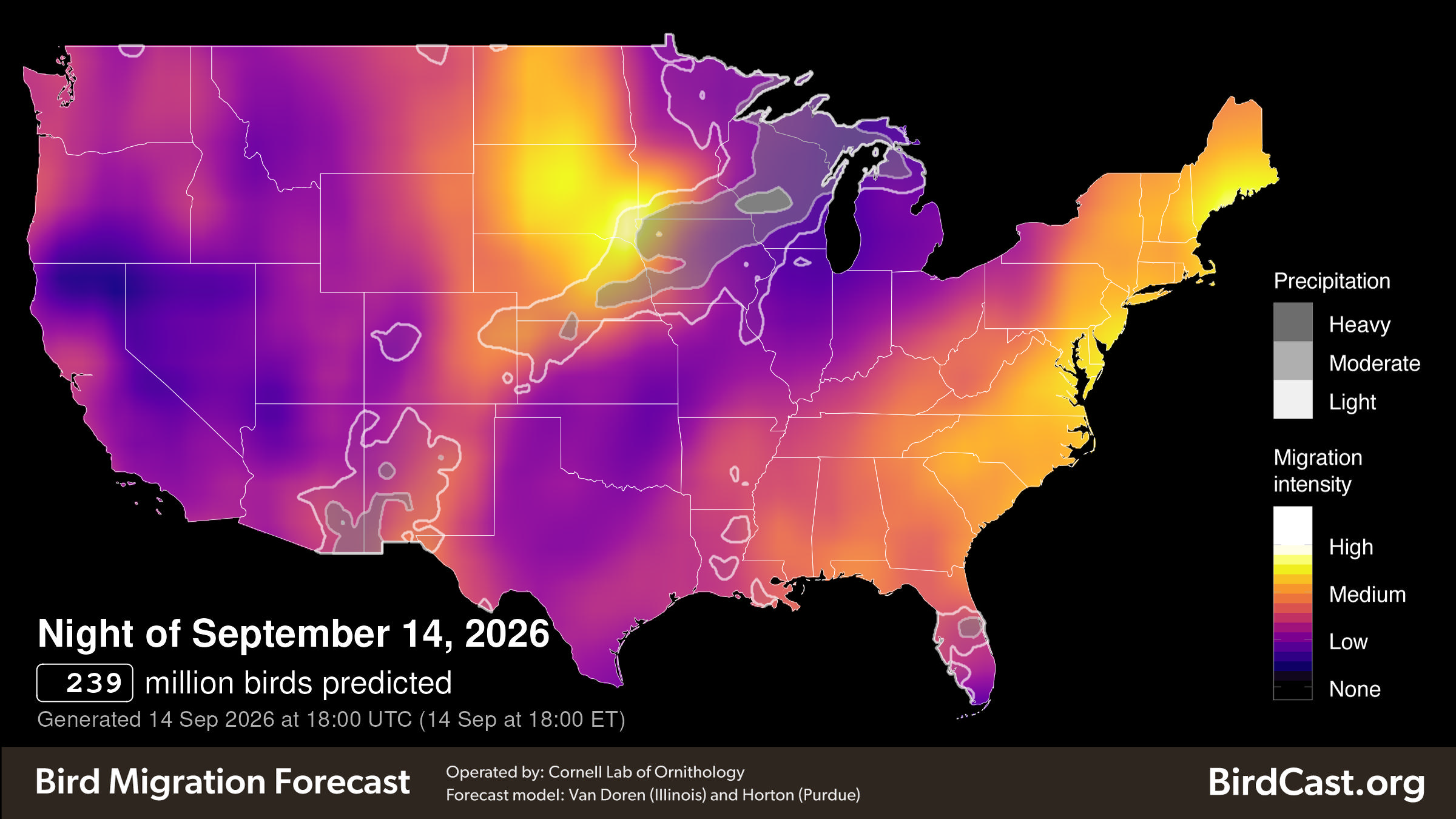
Date: 9/15/26 8:35 am From: Gyekis, Joseph Peter <jpg186...> Subject: Re: Jacks Mountain (14 Sep 2026) 1219 Raptors
Just had over 100 broad winged hawks over hub lawn on campus in 10 minutes!
________________________________
From: State College (PA) Bird Club <SCBIRDCL...> on behalf of Gyekis, Joseph Peter <jpg186...>
Sent: Monday, September 14, 2026 8:05 PM
To: <SCBIRDCL...> <SCBIRDCL...>
Subject: Re: Jacks Mountain (14 Sep 2026) 1219 Raptors
wow Jen, great count, what a beautiful day to be on the ridge
________________________________
From: State College (PA) Bird Club <SCBIRDCL...> on behalf of Hawkcount.org reports <reports...>
Sent: Monday, September 14, 2026 7:58:05 PM
To: <SCBIRDCL...> <SCBIRDCL...>
Subject: Jacks Mountain (14 Sep 2026) 1219 Raptors
Observation start time:
07:45:00
Observation end time:
16:00:00
Total observation time:
8.25 hours
Official Counter
Jen Lee
Observers:
Diane Stewart
Visitors:
No visitors, but a great group of hawk watching chicks on the mountain! Deena, Carol, Jo and Diane were FANTASTIC scanners of the skies for today's big count!!
Weather:
A beautiful fall day! High of low 70s. Moderate winds from NNW all day. Very few clouds early but they gradually built up to help us spot the raptors.
Raptor Observations:
BWs were streaming early. Saw my first few about 2 mins after arrival and boom, the clicker was humming!. Streaming at high naked eye level, straight down the ridge to start. Birds went from high naked eye to mid/high binocular view fairly quickly. They also used both sides and middle of the ridge, with some streams starting on one side, crossing over and finishing on the other side. A few kettles up to 40-50 birds. Steady flow of birds all morning, tapered down from noon onward. We hoped for a late fallout but struck out. My first Harrier (female or imm.) of this season. 1 Am.Kestrel swooped in to check out our owl and landed on the top of the telephone pole 15 ft away. Later 2 Am. Kestrels came in an landed on the old tower for a few minutes.
Non-raptor Observations:
First Cormorants (13), TVs/BVs not counted, Modo, raven, cedar waxwing. Chim.swifts, Goldfinch, chickadee, hummers. Tree swallows, towhee calling, rb.nuthatch beeping.
Predictions:
Just might be another big day with the more favorable, for Jack's, SSE winds being forecast!!
From: State College (PA) Bird Club <SCBIRDCL...> On Behalf Of Lee, Jen
Sent: Monday, September 14, 2026 8:08 PM
To: <SCBIRDCL...>
Subject: NY PA Migration Alert for 14 Sep 2026
YIPPIE
~ Jen
________________________________
From: BirdCast Northeast Notifications <birdcast-alert...><mailto:<birdcast-alert...>> Sent: Monday, September 14, 2026 2:02:40 PM
To: Lee, Jen <jal21...><mailto:<jal21...>> Subject: NY PA Migration Alert for 14 Sep 2026
The Cornell Lab of Ornithology is a membership institution dedicated to interpreting and conserving the earth's biological diversity through research, education, and citizen science focused on birds.
Our mailing address is:
159 Sapsucker Woods Rd., Ithaca, NY 14850
Sure. Both watches would love the extra eyes and to share in the fun !
Jacks is on the Jacks Mt ridge just south of Belleville and Stone is on the Stone Mt ridge just north of Belleville.
JACKS: N 40.54347, W -77.75703
From State College - 322 East to Reedsville, 655 South, Front Mountain Rd to Wills Rd/Jacks Mt Rd to the top of the ridge and the gravel parking lot on the Right, Watch site right there.
Bring a chair, sunscreen (AM full sun, PM some shade), a snack and your bins !
STONE: N 40.56896, W -77.82859
Best to input coordinates into your GPS or Google Maps - The drive involves State Forest gravel roads last few miles up to the top of the Mt. and then a ~10-20 min hike along the ridgetop.
From State College - PA-26 South to McAlevy's Fort
Turn Left on PA-305 East
Right on Barr Rd
Right on E. Branch Rd
Left on Allensville Rd/T508 (Game Lands Gravel from here)
There are a few connecting gravel roads from here - the GPS will get you to the top and to the Gravel Parking area. Park and hike the top of the ridge to the Northeast 10-20 mins. Follow the Mid-State Trail path along the ridge top (over 3-4 rock outcroppings) to the platform location. Minimal seating, bench for counters, room for maybe 3 chairs but carrying in is difficult. Sunscreen - no shade !
From: Jeff Gallo <psugallo...>
Sent: Monday, September 14, 2026 9:22 PM
To: <SCBIRDCL...>; Lee, Jen <jal21...>
Subject: Re: Jacks Mountain (14 Sep 2026) 1219 Raptors
Can you remind us all of the directions/tips for coming out to visit the Jacks Mountain hawk watch? (And/or Stone Mt for that matter.)
Apologies if this was shared recently and I overlooked.
Thanks!
________________________________
From: State College (PA) Bird Club <SCBIRDCL...><mailto:<SCBIRDCL...>> on behalf of Lee, Jen <jal21...><mailto:<jal21...>> Sent: Monday, September 14, 2026 9:16 PM
To: <SCBIRDCL...><mailto:<SCBIRDCL...> <SCBIRDCL...><mailto:<SCBIRDCL...>> Subject: Re: Jacks Mountain (14 Sep 2026) 1219 Raptors
Thanks! Stone Mt had a great day too. Hoping for a top 10 BW at Jacks (1600+).
~ Jen
________________________________
From: State College (PA) Bird Club <SCBIRDCL...><mailto:<SCBIRDCL...>> on behalf of Gyekis, Joseph Peter <jpg186...><mailto:<jpg186...>> Sent: Monday, 14 September 2026 20:05:01
To: <SCBIRDCL...><mailto:<SCBIRDCL...> <SCBIRDCL...><mailto:<SCBIRDCL...>> Subject: Re: Jacks Mountain (14 Sep 2026) 1219 Raptors
wow Jen, great count, what a beautiful day to be on the ridge
________________________________
From: State College (PA) Bird Club <SCBIRDCL...><mailto:<SCBIRDCL...>> on behalf of Hawkcount.org reports <reports...><mailto:<reports...>> Sent: Monday, September 14, 2026 7:58:05 PM
To: <SCBIRDCL...><mailto:<SCBIRDCL...> <SCBIRDCL...><mailto:<SCBIRDCL...>> Subject: Jacks Mountain (14 Sep 2026) 1219 Raptors
Observation start time:
07:45:00
Observation end time:
16:00:00
Total observation time:
8.25 hours
Official Counter
Jen Lee
Observers:
Diane Stewart
Visitors:
No visitors, but a great group of hawk watching chicks on the mountain! Deena, Carol, Jo and Diane were FANTASTIC scanners of the skies for today's big count!!
Weather:
A beautiful fall day! High of low 70s. Moderate winds from NNW all day. Very few clouds early but they gradually built up to help us spot the raptors.
Raptor Observations:
BWs were streaming early. Saw my first few about 2 mins after arrival and boom, the clicker was humming!. Streaming at high naked eye level, straight down the ridge to start. Birds went from high naked eye to mid/high binocular view fairly quickly. They also used both sides and middle of the ridge, with some streams starting on one side, crossing over and finishing on the other side. A few kettles up to 40-50 birds. Steady flow of birds all morning, tapered down from noon onward. We hoped for a late fallout but struck out. My first Harrier (female or imm.) of this season. 1 Am.Kestrel swooped in to check out our owl and landed on the top of the telephone pole 15 ft away. Later 2 Am. Kestrels came in an landed on the old tower for a few minutes.
Non-raptor Observations:
First Cormorants (13), TVs/BVs not counted, Modo, raven, cedar waxwing. Chim.swifts, Goldfinch, chickadee, hummers. Tree swallows, towhee calling, rb.nuthatch beeping.
Can you remind us all of the directions/tips for coming out to visit the Jacks Mountain hawk watch? (And/or Stone Mt for that matter.)
Apologies if this was shared recently and I overlooked.
Thanks!
________________________________
From: State College (PA) Bird Club <SCBIRDCL...> on behalf of Lee, Jen <jal21...>
Sent: Monday, September 14, 2026 9:16 PM
To: <SCBIRDCL...> <SCBIRDCL...>
Subject: Re: Jacks Mountain (14 Sep 2026) 1219 Raptors
Thanks! Stone Mt had a great day too. Hoping for a top 10 BW at Jacks (1600+).
~ Jen
________________________________
From: State College (PA) Bird Club <SCBIRDCL...> on behalf of Gyekis, Joseph Peter <jpg186...>
Sent: Monday, 14 September 2026 20:05:01
To: <SCBIRDCL...> <SCBIRDCL...>
Subject: Re: Jacks Mountain (14 Sep 2026) 1219 Raptors
wow Jen, great count, what a beautiful day to be on the ridge
________________________________
From: State College (PA) Bird Club <SCBIRDCL...> on behalf of Hawkcount.org reports <reports...>
Sent: Monday, September 14, 2026 7:58:05 PM
To: <SCBIRDCL...> <SCBIRDCL...>
Subject: Jacks Mountain (14 Sep 2026) 1219 Raptors
Observation start time: 07:45:00
Observation end time: 16:00:00
Total observation time: 8.25 hours
Official Counter Jen Lee
Observers: Diane Stewart
Visitors:
No visitors, but a great group of hawk watching chicks on the mountain! Deena, Carol, Jo and Diane were FANTASTIC scanners of the skies for today's big count!!
Weather:
A beautiful fall day! High of low 70s. Moderate winds from NNW all day. Very few clouds early but they gradually built up to help us spot the raptors.
Raptor Observations:
BWs were streaming early. Saw my first few about 2 mins after arrival and boom, the clicker was humming!. Streaming at high naked eye level, straight down the ridge to start. Birds went from high naked eye to mid/high binocular view fairly quickly. They also used both sides and middle of the ridge, with some streams starting on one side, crossing over and finishing on the other side. A few kettles up to 40-50 birds. Steady flow of birds all morning, tapered down from noon onward. We hoped for a late fallout but struck out. My first Harrier (female or imm.) of this season. 1 Am.Kestrel swooped in to check out our owl and landed on the top of the telephone pole 15 ft away. Later 2 Am. Kestrels came in an landed on the old tower for a few minutes.
Non-raptor Observations:
First Cormorants (13), TVs/BVs not counted, Modo, raven, cedar waxwing. Chim.swifts, Goldfinch, chickadee, hummers. Tree swallows, towhee calling, rb.nuthatch beeping.
Predictions:
Just might be another big day with the more favorable, for Jack's, SSE winds being forecast!!
Thanks! Stone Mt had a great day too. Hoping for a top 10 BW at Jacks (1600+).
~ Jen
________________________________
From: State College (PA) Bird Club <SCBIRDCL...> on behalf of Gyekis, Joseph Peter <jpg186...>
Sent: Monday, 14 September 2026 20:05:01
To: <SCBIRDCL...> <SCBIRDCL...>
Subject: Re: Jacks Mountain (14 Sep 2026) 1219 Raptors
wow Jen, great count, what a beautiful day to be on the ridge
________________________________
From: State College (PA) Bird Club <SCBIRDCL...> on behalf of Hawkcount.org reports <reports...>
Sent: Monday, September 14, 2026 7:58:05 PM
To: <SCBIRDCL...> <SCBIRDCL...>
Subject: Jacks Mountain (14 Sep 2026) 1219 Raptors
Observation start time: 07:45:00
Observation end time: 16:00:00
Total observation time: 8.25 hours
Official Counter Jen Lee
Observers: Diane Stewart
Visitors:
No visitors, but a great group of hawk watching chicks on the mountain! Deena, Carol, Jo and Diane were FANTASTIC scanners of the skies for today's big count!!
Weather:
A beautiful fall day! High of low 70s. Moderate winds from NNW all day. Very few clouds early but they gradually built up to help us spot the raptors.
Raptor Observations:
BWs were streaming early. Saw my first few about 2 mins after arrival and boom, the clicker was humming!. Streaming at high naked eye level, straight down the ridge to start. Birds went from high naked eye to mid/high binocular view fairly quickly. They also used both sides and middle of the ridge, with some streams starting on one side, crossing over and finishing on the other side. A few kettles up to 40-50 birds. Steady flow of birds all morning, tapered down from noon onward. We hoped for a late fallout but struck out. My first Harrier (female or imm.) of this season. 1 Am.Kestrel swooped in to check out our owl and landed on the top of the telephone pole 15 ft away. Later 2 Am. Kestrels came in an landed on the old tower for a few minutes.
Non-raptor Observations:
First Cormorants (13), TVs/BVs not counted, Modo, raven, cedar waxwing. Chim.swifts, Goldfinch, chickadee, hummers. Tree swallows, towhee calling, rb.nuthatch beeping.
Predictions:
Just might be another big day with the more favorable, for Jack's, SSE winds being forecast!!
Observation start time: 06:00:00 Observation end time: 16:30:00 Total observation time: 10.5 hours
Official Counter: Connor Schmitt
Observers: David Kyler, Greg Grove
Visitors: A few campers from Raystown stopped by for a few minutes. Also a few local track stars.
Weather: Mostly Sunny with some good winds from the NW. Temperature ranged from low 60s in the morning to low 70s in the afternoon. Great day to be on the mountain
Raptor Observations: Good movement of migrating raptors throughout the day, but mainly in the late morning. From 9-11 there was a massive movement of Broad-wingeds, with 336 being seen just from 9-10. More slowly trickled throughout the day. Good diversity in raptor species as well.
Non-raptor Observations: Total species on the day: 36 Non-raptor species seen: Pigeon, Nighthawk Chimney Swifts, Hummingbirds, Black and Turkey Vultures, Barred Owl, Red-bellied Woodpecker, Downy and Hairy Woodpeckers, Flicker, Yellow-throated Vireo, Blue Jays, Am. Crow, Ravens, Chickadees, Tree Swallows, Barn Swallow, RB Nuthatch, Carolina Wren, Waxwings, Goldfinches, Towhee, Tennessee Warbler, Cape May Warblers, Blackpoll Warbler, Yellow-rumped Warbler, Black-throated Green Warbler, and my favorite species: New World Warbler sp.
Predictions: S-SW winds may make for a slow day, but I'm no Nostradamus. ======================================================================== Report submitted by Connor Schmitt (<cschmitts12...>)
Date: 9/14/26 5:08 pm From: Lee, Jen <jal21...> Subject: NY PA Migration Alert for 14 Sep 2026
YIPPIE
~ Jen
________________________________
From: BirdCast Northeast Notifications <birdcast-alert...>
Sent: Monday, September 14, 2026 2:02:40 PM
To: Lee, Jen <jal21...>
Subject: NY PA Migration Alert for 14 Sep 2026
Date: 9/14/26 5:05 pm From: Gyekis, Joseph Peter <jpg186...> Subject: Re: Jacks Mountain (14 Sep 2026) 1219 Raptors
wow Jen, great count, what a beautiful day to be on the ridge
________________________________
From: State College (PA) Bird Club <SCBIRDCL...> on behalf of Hawkcount.org reports <reports...>
Sent: Monday, September 14, 2026 7:58:05 PM
To: <SCBIRDCL...> <SCBIRDCL...>
Subject: Jacks Mountain (14 Sep 2026) 1219 Raptors
Observation start time: 07:45:00
Observation end time: 16:00:00
Total observation time: 8.25 hours
Official Counter Jen Lee
Observers: Diane Stewart
Visitors:
No visitors, but a great group of hawk watching chicks on the mountain! Deena, Carol, Jo and Diane were FANTASTIC scanners of the skies for today's big count!!
Weather:
A beautiful fall day! High of low 70s. Moderate winds from NNW all day. Very few clouds early but they gradually built up to help us spot the raptors.
Raptor Observations:
BWs were streaming early. Saw my first few about 2 mins after arrival and boom, the clicker was humming!. Streaming at high naked eye level, straight down the ridge to start. Birds went from high naked eye to mid/high binocular view fairly quickly. They also used both sides and middle of the ridge, with some streams starting on one side, crossing over and finishing on the other side. A few kettles up to 40-50 birds. Steady flow of birds all morning, tapered down from noon onward. We hoped for a late fallout but struck out. My first Harrier (female or imm.) of this season. 1 Am.Kestrel swooped in to check out our owl and landed on the top of the telephone pole 15 ft away. Later 2 Am. Kestrels came in an landed on the old tower for a few minutes.
Non-raptor Observations:
First Cormorants (13), TVs/BVs not counted, Modo, raven, cedar waxwing. Chim.swifts, Goldfinch, chickadee, hummers. Tree swallows, towhee calling, rb.nuthatch beeping.
Predictions:
Just might be another big day with the more favorable, for Jack's, SSE winds being forecast!!
Observation start time: 07:45:00 Observation end time: 16:00:00 Total observation time: 8.25 hours
Official Counter: Jen Lee
Observers: Diane Stewart
Visitors: No visitors, but a great group of hawk watching chicks on the mountain! Deena, Carol, Jo and Diane were FANTASTIC scanners of the skies for today's big count!!
Weather: A beautiful fall day! High of low 70s. Moderate winds from NNW all day. Very few clouds early but they gradually built up to help us spot the raptors.
Raptor Observations: BWs were streaming early. Saw my first few about 2 mins after arrival and boom, the clicker was humming!. Streaming at high naked eye level, straight down the ridge to start. Birds went from high naked eye to mid/high binocular view fairly quickly. They also used both sides and middle of the ridge, with some streams starting on one side, crossing over and finishing on the other side. A few kettles up to 40-50 birds. Steady flow of birds all morning, tapered down from noon onward. We hoped for a late fallout but struck out. My first Harrier (female or imm.) of this season. 1 Am.Kestrel swooped in to check out our owl and landed on the top of the telephone pole 15 ft away. Later 2 Am. Kestrels came in an landed on the old tower for a few minutes.
Non-raptor Observations: First Cormorants (13), TVs/BVs not counted, Modo, raven, cedar waxwing. Chim.swifts, Goldfinch, chickadee, hummers. Tree swallows, towhee calling, rb.nuthatch beeping.
Predictions: Just might be another big day with the more favorable, for Jack's, SSE winds being forecast!! ======================================================================== Report submitted by Darrell Smith (<oleagleye...>)
Thanks for the replies. We saw three BW today and my wife was able to photograph two of them.
Brent
On 9/14/2026 10:31 AM, Brent Bacon wrote: > I'm wondering if anyone has any ideas why there are so many > Broad-winged Hawks this year. I'm near the Spruce Run Area of the > Bald Eagle SF, and my wife and I have been seeing and photographing a > lot of immature Broad-winged Hawks. I will attach a few or our > pictures. This is just a few. We have been afforded some excellent > opportunities. > > Brent Bacon > > Lewisburg, Pa
Date: 9/14/26 10:17 am From: KATHLEEN BECHDEL <0000d165c6a818d5-dmarc-request...> Subject: Bird watching opportunities this week
Hello, all,
Check out these opportunities to join guided bird walks this week.
In addition to the walk at Tudek Park (see information below) you can join us for the Millbrook Marsh Walk on Tuesday, September 15 from 8:00 - 9:30 am, Shaver's Creek Morning Migration Walk on Wednesday, September 16 from 7:30 - 9:00 am and Arboretum Walk on Thursday, September 17 from 8:00 - 9:30 am.
Additional information and other upcoming events are on our website scbirdcl.org.
Tudek Park
Saturday, September 19, 10:00 am - 11:00 am
Trip Leader: Constanza Ehrenhaus
This walk will be designed for beginner birders, especially families with children. Of course, all are welcome. The area is stroller-friendly, and the walk will be kept to one hour to fit younger learners' attention spans. We will meet in the parking lot.
This field trip is open to members and non-members.
Date: 9/14/26 9:40 am From: Grove, Deborah Shuey <dsg4...> Subject: Re: BWHA
Btw I took a friend to Lost Creek Shoe Shop to buy Binocs and Paul found us several kettles flying over the barn. A few miles from a mountain.
So I didn’t even have to go to a mountain Hawkwatch.
And yes she got a great pair with lots of help from young Aden.
Deb
Deborah S. Grove
________________________________
From: State College (PA) Bird Club <SCBIRDCL...> on behalf of Grove, Gregory William <gwg2...>
Sent: Monday, 14 September 2026 10:58:56
To: <SCBIRDCL...> <SCBIRDCL...>
Subject: Re: BWHA
Hawk watches in PA are getting fairly large numbers a bit ahead of the usual peak timing (third week Sept).
Perhaps it was a good year for reproduction as you mentioned seeing many Immatures.
Or BWs could be leaving northern grounds a bit early because of weather conditions or fire or whatever.
Greg Grove
eBird reviewer: Blair, Cambria, Clearfield, Huntingdon, Juniata, Mifflin
PBA Ridge and Valley Coordinator
Stone Mt. Hawk Watch, Winter Raptor Survey
Huntingdon, PA.
________________________________
From: State College (PA) Bird Club <SCBIRDCL...> on behalf of Brent Bacon <00003a0903e6da96-dmarc-request...>
Sent: Monday, September 14, 2026 10:31 AM
To: <SCBIRDCL...> <SCBIRDCL...>
Subject: BWHA
I'm wondering if anyone has any ideas why there are so many Broad-winged
Hawks this year. I'm near the Spruce Run Area of the Bald Eagle SF, and
my wife and I have been seeing and photographing a lot of immature
Broad-winged Hawks. I will attach a few or our pictures. This is just
a few. We have been afforded some excellent opportunities.
Date: 9/14/26 7:59 am From: Grove, Gregory William <gwg2...> Subject: Re: BWHA
Hawk watches in PA are getting fairly large numbers a bit ahead of the usual peak timing (third week Sept).
Perhaps it was a good year for reproduction as you mentioned seeing many Immatures.
Or BWs could be leaving northern grounds a bit early because of weather conditions or fire or whatever.
Greg Grove
eBird reviewer: Blair, Cambria, Clearfield, Huntingdon, Juniata, Mifflin
PBA Ridge and Valley Coordinator
Stone Mt. Hawk Watch, Winter Raptor Survey
Huntingdon, PA.
________________________________
From: State College (PA) Bird Club <SCBIRDCL...> on behalf of Brent Bacon <00003a0903e6da96-dmarc-request...>
Sent: Monday, September 14, 2026 10:31 AM
To: <SCBIRDCL...> <SCBIRDCL...>
Subject: BWHA
I'm wondering if anyone has any ideas why there are so many Broad-winged
Hawks this year. I'm near the Spruce Run Area of the Bald Eagle SF, and
my wife and I have been seeing and photographing a lot of immature
Broad-winged Hawks. I will attach a few or our pictures. This is just
a few. We have been afforded some excellent opportunities.
Date: 9/14/26 7:32 am From: Brent Bacon <00003a0903e6da96-dmarc-request...> Subject: BWHA
I'm wondering if anyone has any ideas why there are so many Broad-winged Hawks this year. I'm near the Spruce Run Area of the Bald Eagle SF, and my wife and I have been seeing and photographing a lot of immature Broad-winged Hawks. I will attach a few or our pictures. This is just a few. We have been afforded some excellent opportunities.
Observation start time: 10:45:00 Observation end time: 17:00:00 Total observation time: 6.25 hours
Official Counter: Nick Bolgiano
Observers:
Visitors: Stephanie Perles and Reid Perles-LeClear from State College. Roseanna from Kish Valley was a superb spotter - I would point out a few BWs and she would count all without binoculars. But the visitors had left when the 800 BWs came through. One young hiker saw them NE of the watch site and asked what they were when he came past.
Weather: Ridge socked in with fog until 1045, when watch began. Wind W 6-7 mph, sky partly cloudy, temp 75-80F. It took awhile for the flight to develop.
Raptor Observations: The 958 BW was our 8th highest daily count in 32 years. About 800 came during 1550-1610, all gliding on the NW side.
Predictions: This is the start of the big BW week, expect Mon-Wed to be decent before rain arrives Thurs. ======================================================================== Report submitted by Nick Bolgiano (<nickbolgiano...>)
Observation start time: 09:00:00 Observation end time: 15:00:00 Total observation time: 6 hours
Official Counter: Ken Tucker
Observers: Darrell Smith
Visitors: Several Amish. Deena and grandson Andre.
Weather: Fog and mist until 11:00 am , then mostly cloudy until late afternoon, becoming party cloudy. Light winds on top of the mountain opening, appeared stronger below clearing, west winds
Raptor Observations: One immature Redtail seen several times not counted,Peregrine Falcon going wrong direction not counted. Otherwise slow day except 5 eagles between 2 and 3 including one with white head but body and tail colored like immature
Non-raptor Observations: Vultures like usual, almost no raven sightings, Towhees and Blue Jays. ======================================================================== Report submitted by Darrell Smith (<oleagleye...>)



![https://nam10.safelinks.protection.outlook.com/?url=https%3A%2F%2Fmcusercontent.com%2Fb35ddb671faf4a16c0ce32406%2Fimages%2F98ece235-ced7-8219-637d-378e1cf4186a.png&data=05%7C02%<7CSCBIRDCL...>%7Cb1a9c8e4a81d4c89c4ab08df132387c7%7C7cf48d453ddb4389a9c1c115526eb52e%7C0%7C0%7C639250715502933710%7CUnknown%7CTWFpbGZsb3d8eyJFbXB0eU1hcGkiOnRydWUsIlYiOiIwLjAuMDAwMCIsIlAiOiJXaW4zMiIsIkFOIjoiTWFpbCIsIldUIjoyfQ%3D%3D%7C0%7C%7C%7C&sdata=h2g%2FIEIAbbynglDueHn5uD3MrsWFG2gP60MpkDPNdoQ%3D&reserved=0]<https://nam10.safelinks.protection.outlook.com/?url=https%3A%2F%2Fus.list-manage.com%2FJRraW4rgcPT%3Fe%3D1bf6dd66d3%26c2id%3D38719deb0a6f3cd0b12c665f5f12d6ef&data=05%7C02%<7CSCBIRDCL...>%7Cb1a9c8e4a81d4c89c4ab08df132387c7%7C7cf48d453ddb4389a9c1c115526eb52e%7C0%7C0%7C639250715502949932%7CUnknown%7CTWFpbGZsb3d8eyJFbXB0eU1hcGkiOnRydWUsIlYiOiIwLjAuMDAwMCIsIlAiOiJXaW4zMiIsIkFOIjoiTWFpbCIsIldUIjoyfQ%3D%3D%7C0%7C%7C%7C&sdata=%2Fo69fL4rP%2F7eWlyYTRYzwg%2F%2FKcHxJuI2b1%2BHOIYQ5t4%3D&reserved=0>](https://nam10.safelinks.protection.outlook.com/?url=https%3A%2F%2Fmcusercontent.com%2Fb35ddb671faf4a16c0ce32406%2Fimages%2F98ece235-ced7-8219-637d-378e1cf4186a.png&data=05%7C02%<7CSCBIRDCL...>%7Cb1a9c8e4a81d4c89c4ab08df132387c7%7C7cf48d453ddb4389a9c1c115526eb52e%7C0%7C0%7C639250715502933710%7CUnknown%7CTWFpbGZsb3d8eyJFbXB0eU1hcGkiOnRydWUsIlYiOiIwLjAuMDAwMCIsIlAiOiJXaW4zMiIsIkFOIjoiTWFpbCIsIldUIjoyfQ%3D%3D%7C0%7C%7C%7C&sdata=h2g%2FIEIAbbynglDueHn5uD3MrsWFG2gP60MpkDPNdoQ%3D&reserved=0%5D<https://nam10.safelinks.protection.outlook.com/?url=https%3A%2F%2Fus.list-manage.com%2FJRraW4rgcPT%3Fe%3D1bf6dd66d3%26c2id%3D38719deb0a6f3cd0b12c665f5f12d6ef&data=05%7C02%<7CSCBIRDCL...>%7Cb1a9c8e4a81d4c89c4ab08df132387c7%7C7cf48d453ddb4389a9c1c115526eb52e%7C0%7C0%7C639250715502949932%7CUnknown%7CTWFpbGZsb3d8eyJFbXB0eU1hcGkiOnRydWUsIlYiOiIwLjAuMDAwMCIsIlAiOiJXaW4zMiIsIkFOIjoiTWFpbCIsIldUIjoyfQ%3D%3D%7C0%7C%7C%7C&sdata=%2Fo69fL4rP%2F7eWlyYTRYzwg%2F%2FKcHxJuI2b1%2BHOIYQ5t4%3D&reserved=0>)


![https://mcusercontent.com/b35ddb671faf4a16c0ce32406/images/98ece235-ced7-8219-637d-378e1cf4186a.png]<https://nam10.safelinks.protection.outlook.com/?url=https%3A%2F%2Fus.list-manage.com%2FJRraW4rgcPT%3Fe%3D1bf6dd66d3%26c2id%3D38719deb0a6f3cd0b12c665f5f12d6ef&data=05%7C02%<7Cscbirdcl...>%7Cdeafb9195f78477081ff08df12bd775d%7C7cf48d453ddb4389a9c1c115526eb52e%7C0%7C0%7C639250277086018335%7CUnknown%7CTWFpbGZsb3d8eyJFbXB0eU1hcGkiOnRydWUsIlYiOiIwLjAuMDAwMCIsIlAiOiJXaW4zMiIsIkFOIjoiTWFpbCIsIldUIjoyfQ%3D%3D%7C0%7C%7C%7C&sdata=jVPwi1rr%2Fir1HqoWdycyvSl8CVNnbKgytbi8M4CnBVk%3D&reserved=0>](https://mcusercontent.com/b35ddb671faf4a16c0ce32406/images/98ece235-ced7-8219-637d-378e1cf4186a.png%5D<https://nam10.safelinks.protection.outlook.com/?url=https%3A%2F%2Fus.list-manage.com%2FJRraW4rgcPT%3Fe%3D1bf6dd66d3%26c2id%3D38719deb0a6f3cd0b12c665f5f12d6ef&data=05%7C02%<7Cscbirdcl...>%7Cdeafb9195f78477081ff08df12bd775d%7C7cf48d453ddb4389a9c1c115526eb52e%7C0%7C0%7C639250277086018335%7CUnknown%7CTWFpbGZsb3d8eyJFbXB0eU1hcGkiOnRydWUsIlYiOiIwLjAuMDAwMCIsIlAiOiJXaW4zMiIsIkFOIjoiTWFpbCIsIldUIjoyfQ%3D%3D%7C0%7C%7C%7C&sdata=jVPwi1rr%2Fir1HqoWdycyvSl8CVNnbKgytbi8M4CnBVk%3D&reserved=0>)